
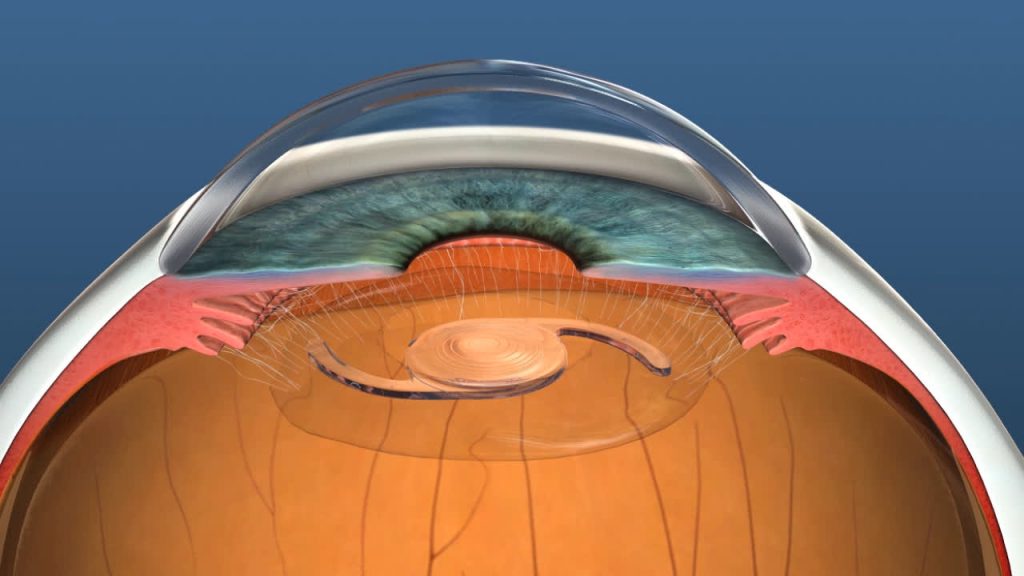
Lens replacement surgery – also known as Refractive Lens Exchange (RLE) – replaces the eye’s natural lens with a carefully selected intraocular lens (IOL). For suitable patients, it can improve distance, intermediate and near vision and significantly reduce the need for glasses or contact lenses.
The same treatment may also be described as refractive lens surgery, refractive lens replacement, Custom Lens Replacement (CLR), Clear Lens Exchange (CLE) or clear lens extraction. These names generally refer to the same core procedure when it is performed to correct vision rather than to treat a cataract.
Prof Billy Power assesses each patient personally and recommends treatment only when the expected benefits justify the risks.

The natural lens sits behind the coloured part of the eye and helps focus light. When we are younger, it changes shape to focus at different distances. With age it becomes less flexible, causing the near-vision difficulty known as presbyopia. This is why many people begin to need reading glasses.
During refractive lens exchange, the natural lens is removed and replaced with an artificial intraocular lens measured for your eye. The operation is technically similar to modern cataract surgery. The main difference is the reason for treatment: RLE is usually performed to correct focusing errors and reduce reliance on glasses before a visually significant cataract has developed.
Because the natural lens has been removed, a cataract cannot later develop in that eye.
Depending on your eyes and the lens selected, RLE may help correct:
The aim is to provide useful vision across the distances that matter in your daily life. No surgeon or lens can guarantee complete freedom from glasses, and some patients may still prefer or need glasses for particular tasks.
Refractive lens exchange is often considered for people in their 50s or older whose natural lens has lost flexibility. It may also be an option for selected patients who:
Suitability cannot be decided by age or prescription alone. Eye health, lifestyle, night-driving needs, occupation and expectations all affect the recommendation. Certain retinal conditions, macular degeneration, glaucoma, corneal disease or significant dry eye may make premium multifocal or EDOF lenses unsuitable.
Highly short-sighted patients require particularly careful assessment because lens surgery may carry an increased risk of retinal detachment.
At the Blackrock Clinic we are very selective about those who are eligible. Safety is our number one priority and we make our decisions based on scientific evidence, declining those who might be at increased risk.
RLE is generally performed as a day-case procedure using local anaesthetic eye drops. A small incision is made, the natural lens is removed and the selected intraocular lens is inserted and positioned inside the eye.
Treatment planning – including whether the eyes are operated on separately and the interval between them – is personalised by your surgeon. You will need someone to bring you home after the procedure.

Extended depth of focus and trifocal lenses are the most commonly used lenses at Blackrock Clinic. Suitability for the lens implant is determined at consultation when numerous tests including the optical properties of the cornea and tear film are evaluated. To work well, these high performance lenses require a cornea with good optical properties as well a surface free of dryness and no streaky tear film. Expectations of how the lens performs will be provided during consultation. Patients must understand the concept of adaptation which involves the brain becoming accustomed to the new optical system and picking up new information. The lens has microscopic rings which provide near vision and as a consequence patients may well experience transient halos that disappear with adaptation.
These lenses divide light to provide focus at more than one distance and may offer a high degree of independence from glasses for distance, screen and near tasks. Some patients notice halos, glare or reduced contrast, particularly at night. These effects often become less noticeable as the visual system adapts, but they may persist for some people.
EDOF lenses are designed to provide an extended range of clear vision, typically prioritising distance and intermediate tasks such as driving and computer use. Reading glasses may still be needed for small print or prolonged close work.
A monofocal lens normally focuses at one main distance. A toric version can also correct suitable levels of astigmatism. Monofocal optics can offer excellent image quality, although glasses are usually required for some distances unless a blended-vision strategy is chosen.
Prof Power will explain the likely benefits, limitations and trade-offs of each appropriate lens rather than recommending a lens by marketing label alone.
The surgical steps are very similar: in both procedures, the natural lens is removed and replaced with an intraocular lens.
With cataract surgery, the natural lens has become cloudy and is removed to restore clearer vision. With refractive lens exchange, the lens may still be clear, but it is replaced to correct the prescription and address age-related loss of near focus.
If a cataract is already affecting your vision, Prof Power will explain whether cataract surgery rather than elective RLE is the appropriate treatment.
Vision may be blurred at first and can fluctuate while the eye heals and the brain adapts to the new optical system. Many patients return to routine activities relatively quickly, but recovery differs between individuals.
You will be given eye drops and instructions about washing, exercise, driving, swimming, make-up and protecting the eye. It is important to attend all scheduled aftercare appointments and contact the clinic promptly if you develop increasing pain, redness or a sudden change in vision.
Your clinical team will provide advice specific to your eyes and procedure. Follow that advice rather than relying on a general online recovery timeline.
Potential benefits for a suitable patient include:
Important limitations include:
Modern lens surgery has a strong safety record in appropriately selected patients, but RLE is an operation inside the eye and is not risk-free.
Possible complications include infection, inflammation, raised eye pressure, corneal swelling, retinal detachment, macular swelling, a tear in the lens capsule, movement of the lens implant and an outcome that differs from the intended prescription. A common later change is posterior capsule opacification, sometimes called “after-cataract,” which can usually be treated with a short YAG laser procedure when appropriate.
Some complications are uncommon but can cause permanent loss of vision. Your individual risk depends on factors including your prescription, eye dimensions and the health of the cornea, retina and optic nerve.
Careful patient selection is central to safety. At Blackrock Clinic, Prof Power will recommend surgery only when he considers you a suitable candidate and will discuss the material risks and alternatives with you before treatment.
Laser eye surgery changes the shape of the cornea while leaving the natural lens in place. Refractive lens exchange replaces the natural lens itself.
Laser treatment may be more appropriate for some younger patients whose natural lens can still focus at near. RLE may be considered when presbyopia or lens changes are a major part of the problem, or where the prescription or cornea makes laser correction less suitable.
The best option can only be identified after a full examination. In some cases, continuing with glasses or contact lenses is the safest recommendation.